8 min read
Disclosure: As an Amazon Associate and eBay Partner Network publisher, we earn from qualifying purchases. This doesn’t affect what we recommend or how we describe it.
Why do so many alarm clocks make you dread mornings, while a sunrise alarm clock can actually make getting up (almost) painless? If you’re tired of being jolted awake by a blaring beep — and you want something that gently nudges you out of bed, even if you’re the kind of person who needs three alarms and a nudge — you’re in the right place. Sunrise alarm clocks use gradually brightening light to simulate a real sunrise, helping your brain and body wake up more naturally. But which one actually fits your needs, and is it worth going for the full-featured model or sticking with something simple?
Top picks at a glance
- Philips HF3500 Wake-up Light Alarm Clock — the entry-level Philips pick
- Philips SmartSleep HF3650/60 Wake-Up Light — the most feature-rich option
What makes sunrise alarm clocks different
Instead of the usual shock-to-the-system noise, sunrise alarms use a light that slowly gets brighter in the 30-40 minutes before your set wake-up time. This isn’t just a gimmick: research suggests that gradual light exposure can help regulate your circadian rhythm, making mornings less brutal (see the Journal of Sleep Health for more on how light cues influence waking). For genuinely forgetful or heavy sleepers, the right sunrise alarm can make the difference between waking up groggy and actually feeling semi-human.
But not all sunrise clocks are created equal. Some offer just the basics — a simple sunrise effect, a single alarm, and maybe a snooze button. Others pile on features: multiple alarm profiles, customizable light colors, and built-in nature sounds. Here’s how the two most relevant options stack up if you’re shopping used on a budget or want all the bells and whistles.
Philips HF3500 Wake-up Light Alarm Clock: the basics, done right
The Philips HF3500 Wake-up Light Alarm Clock is the entry-level pick from Philips, and it sticks to the essentials. You get a sunrise simulation that ramps up over 30 minutes, a single alarm time, and a backup beeper for those mornings when light alone doesn’t cut it. The controls are simple — no menus to scroll through or settings to fiddle with. The light maxes out at 200 lux, which is bright enough to fill a small bedroom but won’t light up the whole house.
If you’re looking for a sunrise effect without spending a fortune, or you just want something that’s easy to set and forget, the Philips HF3500 is the best fit. Just know you won’t get fancy features like customizable colors or multiple alarms. It’s also only available used, so keep an eye on the condition.
Philips SmartSleep HF3650/60 Wake-Up Light: the feature-packed upgrade
At the other end, the Philips SmartSleep HF3650/60 Wake-Up Light is the most feature-rich option in this lineup. On paper, it’s a big step up: you get customizable sunrise and sunset routines, a choice of five different wake-up sounds (including birdsong and gentle music), and a reading lamp function that goes up to 315 lux. The display dims automatically based on room light, and there’s a tap-to-snooze feature for those mornings when you need just five more minutes.
If you want more control over your wake-up routine, share your alarm with a partner, or just like having options, the Philips SmartSleep HF3650 offers the most flexibility. It costs significantly more than the entry-level option (even used), but for heavy sleepers or anyone with a tricky sleep schedule, the extra features may be worth it.
Side-by-side comparison
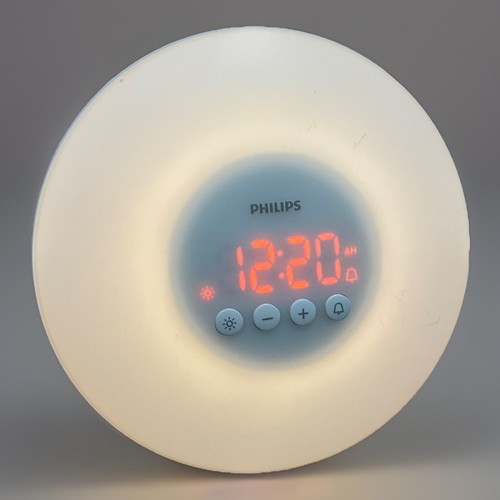
Pictured: Philips HF3500
| Product | Condition | Price | Best For | Max Brightness | Alarm Sounds |
|---|---|---|---|---|---|
| Philips HF3500 Wake-up Light Alarm Clock |
Used | $ | Entry-level Philips pick | 200 lux | Beep only |
 Philips SmartSleep HF3650/60 Wake-Up Light Philips SmartSleep HF3650/60 Wake-Up Light |
Used | $$$ | Most feature-rich option | 315 lux | 5 sounds + beep |
$ / $$ / $$$ indicates budget / mid-range / premium relative to the picks above. Check live listings further down for current prices.
How these sunrise clocks made the shortlist
The shortlist here is focused on products with a proven track record and clear specifications. We prioritized models with a true sunrise simulation (gradual light increase of at least 20 minutes), reliable alarm accuracy, and a light output above 150 lux — bright enough to actually wake you up in a dark room. Extra points went to options with backup sound alarms (for heavy sleepers), adjustable brightness, and user-friendly controls.
We compared the listed specs and features of each model, weighing things like maximum brightness, number of alarm sounds, and the presence of features like auto-dimming displays and snooze functions. Only products with clear manufacturer details and a recognizable brand made the cut; generic or unbranded models, as well as bundles with extra gadgets that obscure the core product, were excluded. If you need a clock for travel, or you want a device with smart home integration, these picks might not fit — they’re best for bedside use and straightforward routines.
Choosing between the Philips HF3500 and Philips SmartSleep HF3650
If you just want a gentle sunrise effect and don’t care about extra features, the Philips HF3500 is the most straightforward (and wallet-friendly) choice. It’s ideal if you’re the type who mainly needs a nudge, not a full orchestra. The controls are basic — set the time, set the alarm, done. The 200-lux brightness is enough for most small to medium bedrooms, but if you’re in a huge room or want to use it as a reading lamp, you may find it a bit dim.
The Philips SmartSleep HF3650, on the other hand, is for people who want to fine-tune every part of their wake-up routine. Customizable sunrise and sunset cycles, five alarm sounds, and a 315-lux lamp mean you get more ways to wake up (or wind down). The auto-dimming display and touch controls are nice touches for anyone who hates fiddling with buttons in the dark. If you share your alarm with a partner or need something that adapts to changing routines, this is the clear upgrade.
Related Guides
Quick decision tree
- If budget is the top concern: Go with the Philips HF3500 for a simple, effective sunrise wake-up without frills.
- If you want maximum brightness or a reading lamp: The Philips SmartSleep HF3650 reaches 315 lux and doubles as a bedside lamp.
- If you need nature sounds or more than one alarm sound: Only the Philips SmartSleep HF3650 offers nature and music wake-up options.
- If you don’t want to fuss with settings: The Philips HF3500 keeps things as simple as possible.
- If you share a bed or have irregular schedules: The Philips SmartSleep HF3650’s multiple features and flexible settings are more adaptable.
FAQ: Sunrise alarm clocks for real-world mornings
Are sunrise alarm clocks actually effective for heavy sleepers?
For some heavy sleepers, sunrise alarms help by starting the waking process before the sound alarm kicks in. However, if you routinely sleep through traditional alarms, you may still need the backup beep (included on both Philips models) or to combine the light with another reminder method.
How long does the sunrise effect take to reach full brightness?
Both the Philips HF3500 and Philips SmartSleep HF3650 ramp up light gradually over 30 minutes before your set wake-up time. This gradual increase is designed to mimic a real sunrise and gently cue your body to wake up.
Which model is better for a shared bedroom?
The Philips SmartSleep HF3650 is the stronger pick for shared spaces. It offers adjustable brightness up to 315 lux and multiple sound options, making it easier to find a setting that works for both you and your partner — or to set different routines for different days.
Is the price jump to the SmartSleep HF3650 worth it?
If you value customizable features, higher brightness, and a choice of alarm sounds, the extra cost for the Philips SmartSleep HF3650 makes sense. If you just want a basic sunrise effect and don’t need extras, the Philips HF3500 covers the essentials for less.
Do these clocks work as bedside reading lamps?
The Philips SmartSleep HF3650 reaches up to 315 lux and is specifically listed as doubling as a reading lamp. The Philips HF3500, at 200 lux, is better for gentle ambient light but may be too dim for reading unless your room is otherwise very dark.
What should I do if I need to return or repair a used sunrise alarm clock?
Because these models are only available used, return and repair options depend on the seller’s policy. Always check the return window and ask about warranty status before buying. Philips does not typically cover used sales under their standard warranty, so factor that into your decision.
Philips HF3500 vs Philips SmartSleep HF3650 — which is better for people who always snooze their alarm?
The Philips SmartSleep HF3650 offers a tap-to-snooze feature and multiple alarm sounds, making it more flexible for chronic snoozers. The Philips HF3500 does have a snooze, but it’s limited to the basic beep sound and simpler controls.
Verdict: Which sunrise alarm clock belongs on your bedside table?
If you want a straightforward, no-nonsense sunrise alarm that gently wakes you up without extra bells and whistles, the Philips HF3500 is the obvious choice — especially if you’re watching your budget. But if you crave more control, extra brightness, and the option to wake up to birdsong (or you just want your alarm to double as a reading lamp), the Philips SmartSleep HF3650 is the clear upgrade. Whichever you choose, you’re likely to find waking up a little less painful — and for genuinely forgetful or easily-distracted people, that’s a win.
If you’re looking for a travel-sized sunrise alarm, or want smart home integration, these models aren’t the right fit — but for everyday bedside use, they’re the best options currently available from Philips in the used market.
For more background on how light exposure affects waking and sleep, see the Journal of Sleep Health or National Heart, Lung, and Blood Institute for science-backed sleep tips.
Still going to forget, aren’t you?
DontForget is a free Telegram reminder app that doesn’t ping once and give up — it hounds you (in a tone you choose, from gentle to brutal) until you actually do the thing. Nothing to download; it runs right inside Telegram.
Try DontForget free →Last updated: June 2026 · How we research and evaluate